
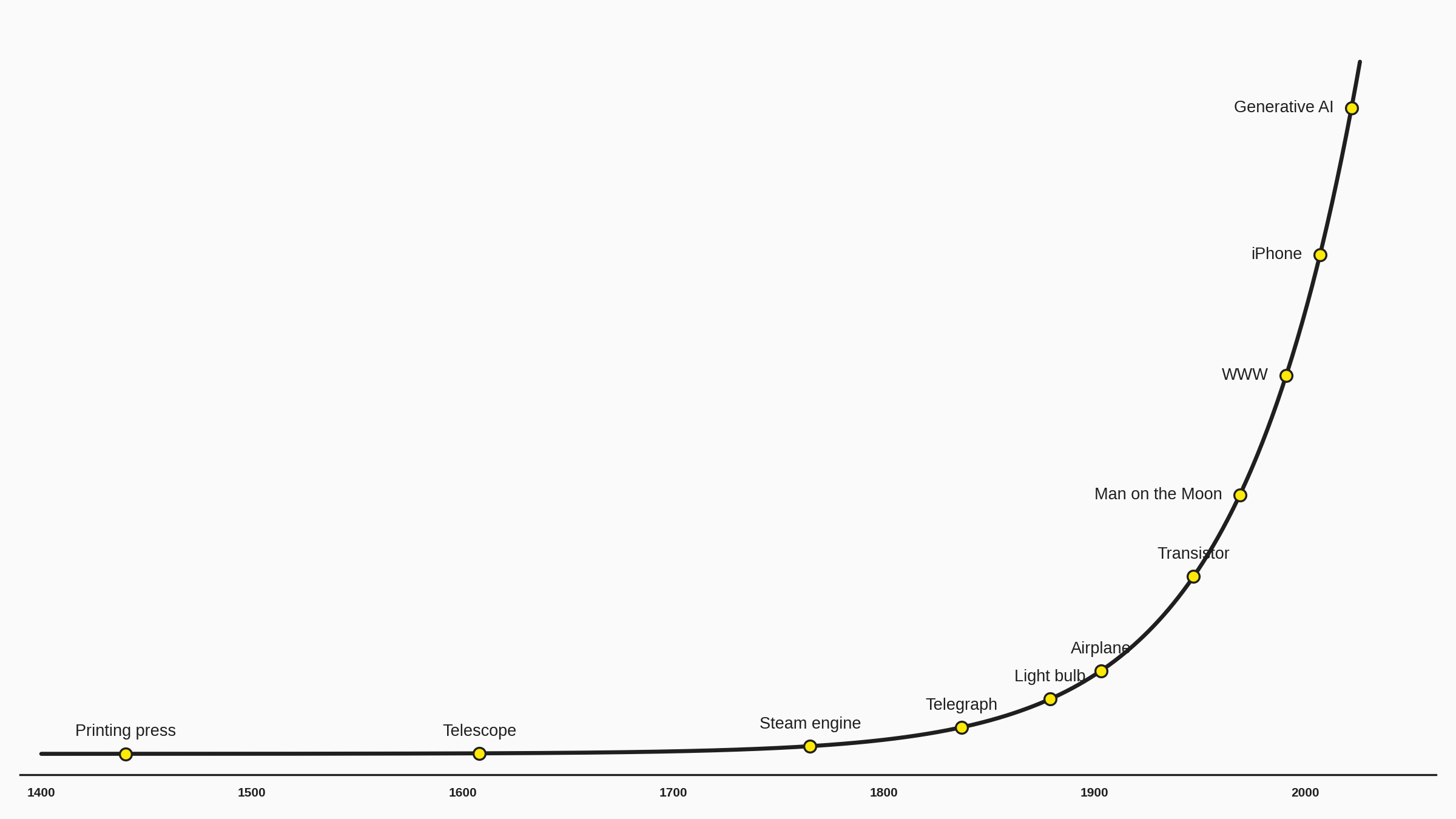
Looking at the curve of global GDP over the past two centuries, we see a world economy that barely grew for millennia and began growing exponentially when technological revolutions started chaining one after another. Every leap (the printing press, the engine, the chip, the internet) multiplied what one person can produce and know. No other tool or human activity has generated so much prosperity in so little time.
The recent version of that story has clear protagonists. In the United States, just six tech industries accounted for more than a third of economic growth over the past decade. And the effect is not limited to there, where it could be attributed to many causes: it also shows in countries that started without a thriving structure and placed the bet. Estonia left the Soviet bloc as one of the poorest countries in Europe; today 99% of its public services are digital and it produces more unicorns per capita than almost any country on the continent. Israel turned a land with no natural resources into a technology powerhouse: the sector accounts for about 20% of its economy and more than half of its exports. South Korea's GDP per capita in 1960 was comparable to Ghana's; it bet on the technology industry and reached the first world in a single generation. None of them was an obvious candidate. All three bet on technology as a development strategy.
And why startups? Because they are the vehicle through which that strategy happens. There is no need to look far: today a corner store anywhere in Argentina takes QR payments with no bank nearby, a small business gets credit by showing its sales instead of its banking history, and a freelancer collects payment from abroad in minutes. Each of those solutions was a startup solving a concrete problem for the rest of the population. And along the way come skilled jobs, knowledge exports and ownership. The world's largest technology companies were startups twenty years ago.
Argentina is once again at a decisive moment in its history. Knowledge is the export that needs no ports and no roads. The products born here are born from real, structural problems, and what solves an Argentine problem tends to solve a Latin American one. We have the talent and we have the necessity.
That technology transforms economies has already been proven. What each country decides is whether to build the environment for it to happen at home or watch it happen elsewhere. Hubs get built. That is what Crecimiento is about. And why it has to happen here: Why Argentina.